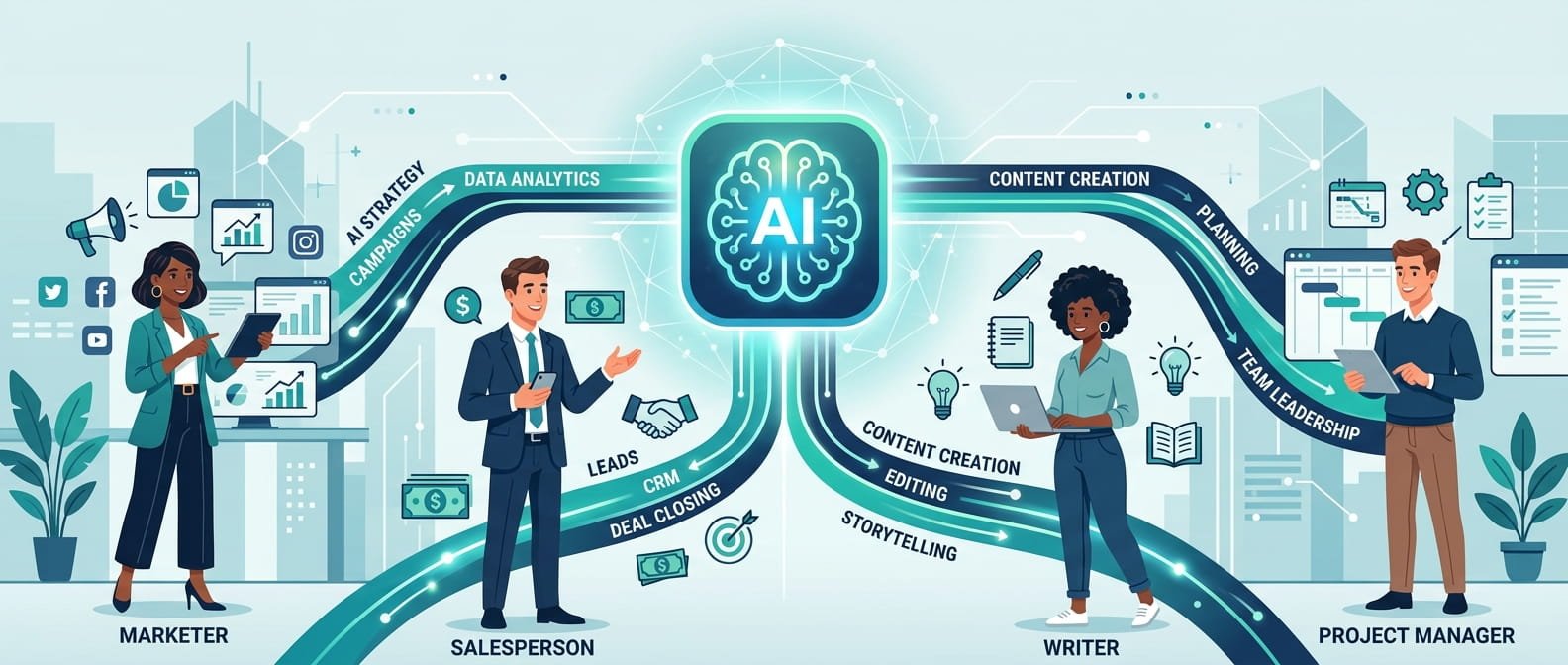
Artificial intelligence is creating new career opportunities, but you don’t necessarily need a computer science degree to work with AI.
While advanced AI engineering and research positions can require strong programming, mathematics, and technical education, many AI-related jobs involve skills that can be developed through experience, certifications, portfolios, or training.
Companies need people who can work with AI tools, manage data, support customers, create content, analyze information, improve business processes, and help teams use new technology effectively.
That means someone with a background in marketing, administration, sales, customer service, writing, design, business, or another field may be able to move into an AI-related career without going back to college for a computer science degree.
The key is understanding which AI jobs match your existing skills and what you need to learn to become competitive.
Do You Need a Computer Science Degree for an AI Job?
No—not for every AI-related position.
The education requirements vary considerably depending on the job.
An AI research scientist or machine learning engineer may need advanced technical knowledge and, in some cases, a bachelor’s or master’s degree in computer science, mathematics, statistics, or a related discipline.
Other AI-related roles can place greater emphasis on communication, business knowledge, analytical ability, industry experience, or practical use of AI tools.
For example, a marketing professional could specialize in AI-assisted marketing, while an experienced customer-service representative could move toward an AI-supported customer-success role.
The important distinction is between building AI technology and using AI technology to solve business problems.
You don’t necessarily need to become an AI engineer to build a career around artificial intelligence.
1. AI Content Specialist

Content is one of the most accessible areas for people who want to combine existing skills with AI.
AI content specialists may use generative AI tools to assist with research, brainstorming, outlines, editing, content workflows, and other tasks.
However, companies still need people who understand:
- Writing
- Research
- Editing
- Audience needs
- Brand voice
- SEO
- Fact-checking
- Content strategy
AI can generate text quickly, but generated content still needs human review.
A person who understands both content creation and AI workflows can potentially offer more value than someone who simply knows how to generate text.
Skills to develop
- Generative AI
- Prompting
- SEO fundamentals
- Content editing
- Research
- Fact-checking
- Content strategy
This can be a particularly practical route for writers, marketers, editors, and communications professionals.
2. AI Marketing Specialist
Marketing is another field where AI is being incorporated into everyday workflows.
AI can assist marketers with research, campaign ideas, customer segmentation, content creation, data analysis, email marketing, and other activities.
An AI marketing specialist may work with marketing teams to identify useful AI applications while still relying on traditional marketing knowledge.
Relevant skills include:
- Digital marketing
- SEO
- Email marketing
- Social media
- Analytics
- Customer research
- Generative AI
- Marketing automation
A marketing background can therefore provide a foundation for moving into AI-related work without requiring a computer science degree.
3. AI Business Analyst
Business analysis is another possible path for people with strong analytical and communication skills.
Business analysts help organizations understand problems, evaluate processes, identify requirements, and recommend improvements.
AI can become an additional tool within that work.
For example, an analyst might use AI to help organize information, summarize documents, analyze business data, or identify patterns that require further investigation.
The valuable combination is:
Business knowledge + analytical thinking + AI literacy
A candidate doesn’t necessarily need to build machine-learning models to contribute to AI-related business projects.
4. AI Project Coordinator
AI projects require more than programmers.
Someone needs to coordinate deadlines, meetings, documentation, requirements, communication, testing, and collaboration between different teams.
This creates opportunities for people with project-management or organizational experience.
An AI project coordinator may work with:
- Developers
- Data teams
- Product managers
- Marketing teams
- Business leaders
- Customers
Useful skills include:
- Project management
- Communication
- Documentation
- Task management
- Organization
- Basic AI knowledge
- Collaboration tools
A project-management background can therefore be useful when companies are introducing AI systems or developing AI-powered products.
5. AI Customer Success Specialist
AI-powered software companies still need people who can help customers understand and successfully use their products.
Customer-success professionals may onboard customers, answer questions, identify problems, provide product guidance, and communicate feedback to internal teams.
If the product is an AI platform, understanding the technology becomes an additional advantage.
You may need to understand:
- How the AI product works at a basic level
- Common customer problems
- Product workflows
- AI limitations
- Data privacy considerations
- How to explain technical concepts simply
This can be an attractive option for people coming from customer service, account management, SaaS, or sales backgrounds.
6. AI Sales Specialist
AI companies need sales professionals who can explain the value of their products to potential customers.
You don’t necessarily need to know how to build an AI model to sell an AI product.
You do need to understand:
- The customer’s problem
- What the product does
- How the AI is being used
- What benefits the product provides
- Potential limitations
- How to communicate value
Sales professionals with strong communication skills can potentially transition into AI-focused sales roles.
Relevant job titles may include:
- AI Sales Representative
- Account Executive
- Business Development Representative
- AI Solutions Consultant
- Sales Development Representative
Some technical sales positions may require more specialized knowledge, so always check the individual job description.
7. AI Operations Specialist
Businesses are increasingly looking for ways to incorporate AI into everyday workflows.
An AI operations specialist may help teams identify repetitive processes that can be improved through AI and automation.
For example, a company might want to automate:
- Document processing
- Internal reporting
- Customer requests
- Data organization
- Email workflows
- Scheduling
- Repetitive administrative tasks
You don’t necessarily need advanced programming knowledge to understand these workflows.
However, learning how APIs, automation platforms, data flows, and AI tools work can make you more competitive.
8. AI Data Annotator
AI systems require data, and some AI-development workflows involve people reviewing, labeling, or organizing information used to train or evaluate models.
Data-annotation work can involve tasks such as:
- Labeling text
- Reviewing images
- Categorizing information
- Evaluating AI responses
- Checking whether outputs meet specific criteria
The requirements vary considerably between employers and projects.
Some positions may require specialized knowledge, while others focus more on attention to detail and following clear guidelines.
Because these roles can vary significantly in quality, pay, availability, and long-term career potential, research the employer and position carefully before accepting an offer.
9. AI Quality or AI Response Evaluator
As companies develop AI systems, they need ways to evaluate whether those systems are producing useful and appropriate results.
Some roles involve reviewing AI-generated responses and assessing them against predefined criteria.
For example, an evaluator may determine whether an AI response is:
- Accurate
- Relevant
- Clear
- Helpful
- Safe
- Consistent with instructions
Strong writing, research, analytical, or subject-matter knowledge can be useful for these positions.
A person with expertise in a particular field may also be able to contribute to AI evaluation within that subject area.
10. AI Training and Enablement Specialist
Companies adopting AI often need employees who can help other workers understand new tools.
An AI training specialist may create training materials, conduct workshops, document workflows, and help employees learn how to use AI responsibly.
This role can combine:
- Communication
- Training
- Presentation skills
- Documentation
- AI literacy
- Business knowledge
If you enjoy teaching or explaining technology to others, this can be an interesting career direction.
11. AI Recruiter or Talent Specialist
Recruiting is another area where AI tools are increasingly relevant.
Recruiters may use technology to organize candidate information, improve sourcing workflows, assist with job descriptions, and manage large volumes of applications.
An AI-focused recruiting professional still needs strong knowledge of:
- Hiring processes
- Candidate communication
- Job descriptions
- Interviewing
- Talent sourcing
- Employer requirements
- Recruitment technology
A recruiting background combined with AI knowledge can create a useful specialization.
12. AI SEO Specialist
Search optimization is another area where AI is changing workflows.
SEO professionals can use AI to assist with:
- Keyword research
- Content planning
- Topic research
- Content briefs
- Competitor analysis
- Search-intent analysis
- Content optimization
But successful SEO requires more than generating articles.
You still need to understand search intent, technical SEO, website structure, internal linking, content quality, user experience, and how search engines evaluate pages.
This means an experienced SEO professional can use AI as a productivity tool without needing a computer science degree.
13. AI-Assisted Graphic or Creative Specialist
People working in design and creative fields can also explore AI-related opportunities.
AI image and design tools can assist with brainstorming, concept development, visual exploration, editing, and production workflows.
However, design fundamentals remain important.
Useful skills include:
- Graphic design
- Typography
- Composition
- Branding
- Image editing
- Creative direction
- AI design tools
Instead of competing with AI, creative professionals can learn how to incorporate AI into their existing workflow.
14. AI Product Support Specialist
AI products can be complicated for new users.
Product-support professionals help customers understand software, troubleshoot problems, and find solutions.
For an AI product, the support specialist may need to understand concepts such as:
- AI model behavior
- Prompting
- Common errors
- Account settings
- Data handling
- Product limitations
- Basic troubleshooting
Strong communication skills can be just as important as technical knowledge.
What Skills Should You Learn if You Don’t Have a CS Degree?
If you’re starting from a non-technical background, don’t try to learn every AI technology at once.
Start with a core set of transferable skills.
AI fundamentals
Understand:
- Generative AI
- Machine learning basics
- Large language models
- AI limitations
- AI automation
- Responsible AI
Generative AI tools
Learn how to use AI for:
- Research
- Writing
- Summarization
- Brainstorming
- Data analysis
- Productivity
- Workflow assistance
Prompting
Learn how to give AI systems clear instructions, provide context, specify output requirements, and evaluate responses.
Data literacy
You don’t necessarily need to become a data scientist, but understanding spreadsheets, basic statistics, data organization, and simple analysis can be valuable.
Automation
Learn how workflows, APIs, triggers, actions, and integrations work.
Communication
AI doesn’t eliminate the need for human communication.
Being able to explain ideas clearly, work with teams, present information, and understand customer needs remains valuable.
Your Existing Career Can Be Your Starting Point
One of the easiest ways to enter an AI-related field may be to add AI skills to a career you already understand.
For example:
Writer → AI Content Specialist
Marketer → AI Marketing Specialist
Recruiter → AI Recruiting Specialist
Customer Support → AI Product Support
Salesperson → AI Sales
Project Manager → AI Project Coordinator
SEO Specialist → AI SEO Specialist
Business Analyst → AI Business Analyst
This approach can be easier than trying to completely reinvent yourself.
Your existing industry knowledge gives you context. AI becomes the additional skill.
Can You Get an AI Job Without Experience?
Some entry-level AI-related opportunities exist, but you should be realistic about the competition.
Employers still want evidence that you can perform the work.
If you don’t have professional AI experience, build your own evidence.
For example, you could:
- Complete practical AI courses
- Build small projects
- Create an AI workflow
- Analyze a dataset
- Build a simple chatbot
- Create an AI-assisted marketing project
- Document an automation
- Evaluate AI responses
- Publish useful examples in a portfolio
A portfolio doesn’t need to be complicated.
One well-documented project can give you something concrete to discuss during an interview.
Do AI Jobs Without a Degree Pay Well?
Compensation varies significantly depending on the position, industry, experience, location, and technical requirements.
An entry-level AI data evaluator and an experienced AI product manager are both “AI-related” jobs, but they can have completely different responsibilities and compensation.
The same applies to technical roles.
A machine-learning engineer may require considerably more specialized knowledge than an AI-focused marketing specialist.
Rather than choosing a career based only on the phrase “AI job,” look at the actual responsibilities, qualifications, salary range, and career progression associated with the position.
How to Put AI Skills on Your Resume
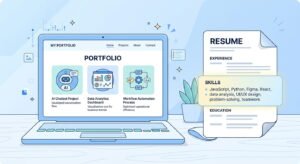
Avoid simply adding a large list of AI tools to your resume.
Show what you actually did.
For example:
Weak:
Artificial Intelligence, ChatGPT, AI Tools
Better:
Developed an AI-assisted content workflow that reduced manual research and drafting time while maintaining human review and fact-checking.
Or:
Built an automated workflow combining AI-generated summaries with spreadsheet-based reporting.
Specific accomplishments are easier for an employer to understand than a collection of tool names.
If you’re applying through an applicant tracking system, keep your resume simple and make sure relevant skills from the job description are included naturally.
Build a Portfolio Before You Apply
If you don’t have a computer science degree, your portfolio can help demonstrate practical ability.
Consider creating three small projects related to the career you’re targeting.
For example, an aspiring AI marketing specialist could create:
Project 1: AI-assisted content strategy
Project 2: AI-powered customer research workflow
Project 3: Automated marketing report
Someone interested in AI operations could instead demonstrate:
Project 1: Automated document workflow
Project 2: AI-powered email classification
Project 3: Automated reporting system
The projects don’t need to be commercial products.
They need to demonstrate that you understand the problem, selected appropriate tools, and can produce a useful result.
A Practical 90-Day Plan

If you’re serious about moving into an AI-related career without a computer science degree, give yourself a structured learning plan.
Days 1–30: Learn the Fundamentals
Focus on AI concepts, generative AI, prompting, responsible AI, and basic automation.
At this stage, don’t worry about becoming an expert.
Your goal is to understand the technology and identify which applications interest you.
Days 31–60: Choose a Career Path
Choose one direction based on your existing experience.
For example:
- AI + marketing
- AI + sales
- AI + content
- AI + recruiting
- AI + customer success
- AI + data
- AI + operations
Then learn the tools and skills relevant to that path.
Days 61–90: Build and Apply
Create one or two practical projects.
Add relevant skills and projects to your resume.
Prepare for interviews and begin applying for positions that match your actual qualifications.
You don’t have to wait until you’ve learned everything.
Continue learning while applying.
What About AI Engineering and Machine Learning?
It’s important to be realistic here.
Some AI careers are highly technical.
If your goal is to become a machine-learning engineer, AI engineer, or AI research scientist, you may need to develop substantial skills in:
- Programming
- Mathematics
- Statistics
- Machine learning
- Data structures
- Algorithms
- Cloud computing
- Model deployment
- Software engineering
A computer science degree can be useful for these careers, but the key issue is the technical skill level required by the specific role.
Don’t assume that because you don’t have a CS degree you cannot enter AI.
Instead, determine what type of AI work you want to do and work backward from the requirements.
The Real Advantage: Combining AI With Another Skill
AI is becoming a tool used across many professions.
That means the most useful career strategy may not be becoming “the AI person.”
It may be becoming the marketing person who understands AI, the recruiter who understands AI, the analyst who uses AI effectively, or the project manager who can coordinate AI implementations.
Your existing expertise can become your advantage.
The goal is to combine it with technology rather than throw it away.
Final Thoughts
You don’t need a computer science degree to start exploring AI-related careers.
There are opportunities in marketing, content, sales, customer success, recruiting, project coordination, operations, data evaluation, SEO, support, and other areas where AI is becoming part of everyday work.
The most practical approach is to build on what you already know.
Learn AI fundamentals, become comfortable with generative AI, develop practical projects, and choose a specific career direction. Then use your resume and portfolio to demonstrate what you can actually do.
For highly technical AI positions, you may need significantly more programming, mathematics, and computer science knowledge. But that shouldn’t stop you from exploring the many other ways AI is being incorporated into modern workplaces.
You don’t have to become an AI engineer to build an AI-related career.
You need to find the intersection between what you already know, what employers need, and what AI can help you do better.
Important Information
AI job titles, employer requirements, compensation, and technology can change quickly. This article provides general career guidance and does not guarantee employment.
Jobnexxa may publish job opportunities collected from external sources. Jobnexxa is not necessarily the employer or recruiter for positions listed on the website. Always verify the employer, job requirements, compensation, location, and application instructions with the actual hiring organization before applying.