
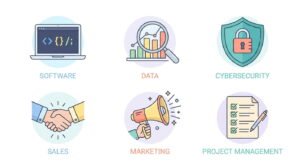
Remote work has changed significantly over the past few years. Working from home is no longer limited to traditional technology jobs, and employers now hire remote workers across areas such as sales, business development, cybersecurity, data, marketing, customer support, administration, and software development.
At the same time, finding a fully remote position in 2026 can be competitive. LinkedIn’s September 2026 U.S. Workforce Report shows that hiring improved in August but remained slower than the previous year, making it important for job seekers to target relevant roles and tailor their applications.
So, which remote careers are worth watching in 2026?
Below are some of the remote-friendly job categories attracting attention, along with the skills employers commonly look for and practical advice for finding these opportunities.
Remote Jobs Are Becoming More Specialized
One of the biggest changes in the remote job market is that employers are increasingly looking for specific skills rather than simply advertising generic “work from home” positions.
FlexJobs reported that fully remote job postings increased 22% in the second quarter of 2026 compared with the previous quarter. Its analysis also identified sales, business development, and account management among the fastest-growing remote career fields during the first half of the year.
That does not mean every job in these categories is remote. A position can be remote-friendly while still requiring employees to live in a particular state, region, or country.
For U.S. citizens searching for remote work, the best approach is therefore to look for jobs that specifically state 100% remote, fully remote, or remote within the United States.
1. Software Developer
Software development remains one of the most established remote career paths.
Developers can work on websites, mobile applications, business software, cloud platforms, artificial intelligence products, and other digital systems without necessarily being physically present in an office.
The U.S. Bureau of Labor Statistics projects 10% employment growth for software developers, quality assurance analysts, and testers from 2025 to 2035. Software developers had a median annual wage of $135,980 in May 2025.
Common skills include:
- JavaScript, Python, Java, C#, or similar programming languages
- Git and version control
- Web or application development
- APIs
- Databases
- Cloud platforms
- Problem-solving
- Testing and debugging
Remote software-development jobs can range from junior developer positions to senior engineering and technical leadership roles.
2. Data Scientist
Data science is another career worth watching in 2026, particularly as businesses continue using data and artificial intelligence to make decisions.
Data scientists analyze large datasets, develop models, identify patterns, and communicate findings to business teams.
According to the BLS, employment of data scientists is projected to grow 35% from 2025 to 2035, considerably faster than the average for all occupations. The median annual wage was $120,230 in May 2025.
A data-science career commonly involves:
- Python or R
- SQL
- Statistics
- Machine learning
- Data visualization
- Predictive modeling
- Communication and business analysis
Because much of this work is performed digitally, some data-science positions can be performed remotely.
3. Cybersecurity Analyst
Cybersecurity has become an important part of nearly every organization’s technology strategy.
Information security analysts help protect networks, systems, applications, and sensitive information from cyber threats. Many of these responsibilities can be performed remotely, although some employers may require occasional onsite work.
The BLS projects 21% employment growth for information security analysts between 2025 and 2035. The occupation had a median annual wage of $129,180 in May 2025.
Employers may look for experience with:
- Network security
- Security monitoring
- Firewalls
- Vulnerability assessment
- Incident response
- Cloud security
- Security tools
- Industry certifications
Cybersecurity can be particularly interesting for professionals who enjoy technology, investigation, and problem-solving.
4. Sales and Business Development
Remote work isn’t limited to technical careers.
Sales and business development have become notable areas of remote hiring. FlexJobs identified sales and business development among the fastest-growing remote career fields during the first half of 2026.
Remote sales professionals may communicate with customers through video calls, email, phone, CRM platforms, and online meetings.
Typical positions include:
- Sales Representative
- Business Development Representative
- Account Executive
- Sales Development Representative
- Business Development Manager
Important skills include communication, prospecting, negotiation, CRM software, relationship building, and understanding customer needs.
For someone who doesn’t want to become a programmer but is comfortable communicating with people, remote sales can be a career path worth exploring.
5. Account Manager
Account management is another remote-friendly field that has attracted attention in 2026.
Account managers generally work with existing customers, help solve problems, maintain relationships, coordinate internal teams, and look for opportunities to retain or expand accounts.
This can be a good fit for people with experience in:
- Customer relationships
- Communication
- Sales
- Project coordination
- Client service
- CRM platforms
The role can vary considerably between companies. Some account managers focus primarily on customer success, while others have significant sales responsibilities.
6. Digital Marketing Specialist
Digital marketing continues to provide opportunities for remote workers because many marketing activities are performed online.
Potential remote positions include:
- SEO Specialist
- Content Marketing Specialist
- Social Media Manager
- Email Marketing Specialist
- PPC Specialist
- Digital Marketing Coordinator
- Marketing Analyst
The skills required depend on the position. Someone working in SEO may focus on search optimization and analytics, while a paid advertising specialist may spend more time managing campaigns and analyzing performance.
Building a portfolio can be especially useful for people trying to enter digital marketing without extensive professional experience.
7. Data Analyst
Data analysts help businesses understand information and turn numbers into useful insights.
Their work can include cleaning datasets, creating reports, building dashboards, identifying trends, and communicating findings to managers or other departments.
Common skills include:
- Excel
- SQL
- Data visualization
- Power BI or Tableau
- Basic statistics
- Business analysis
Data analysis can be a useful entry point for people interested in data careers but who are not yet ready to pursue a more advanced data-science position.
8. Project Manager
Remote project management has also become an important career option.
Project managers coordinate people, deadlines, budgets, tasks, and deliverables. Much of this work can be handled through project-management software and online communication tools.
Remote project-management positions can be found in technology, marketing, consulting, healthcare, finance, construction-related administration, and other industries.
Useful skills include:
- Organization
- Communication
- Scheduling
- Risk management
- Budget awareness
- Team coordination
- Project-management software
Professional certifications may also help depending on the employer and industry.
9. Customer Support and Customer Success
Customer-facing remote work remains common, particularly for software companies, online services, e-commerce businesses, and subscription-based products.
Possible job titles include:
- Customer Support Representative
- Customer Success Specialist
- Technical Support Representative
- Customer Experience Specialist
- Client Support Specialist
However, job seekers should pay attention to the difference between short-term hiring volume and long-term occupational growth.
The BLS projects overall employment of customer service representatives to decline 5.5% from 2024 to 2034, partly because technology and productivity improvements can reduce demand for some traditional customer-service work.
That doesn’t mean remote customer-service jobs have disappeared. It means candidates should consider developing additional skills such as technical support, customer success, CRM management, or specialized industry knowledge.
10. Virtual Assistant and Administrative Roles
Virtual assistants support businesses and individuals with tasks such as scheduling, email management, data entry, research, document preparation, and administrative coordination.
These jobs can be attractive to people who want to begin working remotely without pursuing a highly technical career.
However, competition can be significant. Candidates can improve their prospects by learning tools such as:
- Microsoft Office
- Google Workspace
- Slack
- Zoom
- CRM platforms
- Project-management software
- Basic spreadsheet functions
Specializing can also help. For example, a virtual assistant who understands real estate, e-commerce, healthcare administration, or social media may have a more specific value proposition than someone offering only general administrative services.
11. AI-Related Remote Jobs
Artificial intelligence is influencing the remote job market in several ways.
LinkedIn’s 2026 Jobs on the Rise research highlighted AI-related positions among the fastest-growing job categories in the United States, including AI engineers, AI consultants and strategists, data annotators, and AI or machine-learning researchers.
The important point for job seekers is that not every AI-related position requires the same technical background.
Some roles require advanced programming and machine-learning knowledge, while others focus more on business implementation, data preparation, research, or helping organizations adopt AI tools.
People interested in this area may want to explore skills such as:
- Python
- Machine learning
- Data analysis
- Prompt design
- AI tools
- Model evaluation
- Automation
- Business process optimization
The BLS also projects strong growth for several technology-related occupations. From 2024 to 2034, employment is projected to grow 33.5% for data scientists, 28.5% for information security analysts, and 15.8% for software developers.
What Skills Matter Most for Remote Jobs in 2026?
A remote job requires more than being able to work from home.
Employers often want people who can work independently, communicate clearly, manage deadlines, and use digital tools effectively.
Some broadly useful skills include:
- Written communication
- Time management
- Problem-solving
- Video conferencing
- Collaboration
- Spreadsheet skills
- Project management
- Digital communication
- Adaptability
- Basic AI-tool literacy
Technical skills can make a candidate more competitive, but strong communication and reliability remain important across many remote positions.
How to Find Legitimate Remote Jobs in the U.S.

Searching for remote jobs requires some caution because “work from home” searches can attract misleading listings and scams.
When searching, look for specific information about:
- Whether the position is fully remote
- Whether applicants must live in the United States
- Whether a particular state is required
- Working hours or time-zone requirements
- Salary or compensation
- Benefits
- The actual employer
- The application process
Be particularly careful if a supposed employer asks you to pay money to receive a job, purchase equipment through an unusual payment arrangement, or provide sensitive financial information before there is a legitimate hiring process.
Whenever possible, verify the position through the employer’s official careers page.
Don’t Limit Your Search to the Word “Remote”
One useful change to your job-search strategy is to search by career category + remote rather than searching only for “remote jobs.”
For example:
- Remote software developer jobs
- Remote data analyst jobs
- Remote cybersecurity jobs
- Remote marketing jobs
- Remote sales jobs
- Remote customer success jobs
- Remote project manager jobs
- Remote AI jobs
This makes it easier to focus on jobs that actually match your experience.
You can also search for terms such as “remote within the U.S.”, “U.S. remote”, or “work from anywhere in the U.S.”
Remember that being a U.S. citizen does not automatically mean every remote position is available to you. Employers can impose location, state, licensing, time-zone, security, or other eligibility requirements.
How to Prepare for a Remote Job Application

Before applying, make sure your resume reflects the skills mentioned in the job description.
If an employer asks for experience with Salesforce, SQL, project management, cybersecurity, or a specific programming language and you genuinely have that experience, make sure it is clearly visible on your resume.
A simple, ATS-friendly resume can also make your application easier for recruiting systems and human reviewers to process.
For candidates changing careers, projects and relevant experience can be useful evidence of your abilities. A portfolio, GitHub profile, writing samples, marketing campaigns, dashboards, or other work examples can strengthen an application when appropriate.
Which Remote Job Should You Explore?
There isn’t one remote career that works for everyone.
A software developer may prioritize technical growth and compensation. Someone with strong communication skills may prefer sales or account management. A person interested in numbers might explore data analysis or data science, while someone with an interest in security could investigate cybersecurity.
The more useful question is not simply “What remote job is trending?”
It is:
“Which growing remote-friendly career matches my existing skills, interests, and the skills I’m willing to develop?”
That approach can lead to a more sustainable job search than chasing every new remote-job trend.
Final Thoughts
Remote employment remains an important part of the U.S. job market in 2026, but the market is competitive and not every remote-friendly occupation is growing at the same rate.
Technology-related careers such as software development, data science, cybersecurity, and AI-related roles are attracting significant attention. At the same time, remote opportunities exist in sales, business development, account management, marketing, project management, customer success, and administrative work.
For job seekers, the strongest strategy is to combine a realistic target role with relevant skills, a well-written resume, and careful research into each employer.
Instead of applying to every listing that says “work from home,” focus on remote positions that genuinely match your experience and build the skills that employers are increasingly requesting.